Liver Disorders
Disease challenges by viruses, bacteria, parasites and toxic compounds
are common in poultry. One of the most significant factor limiting efficiency and
good performance is disease. Hence if disease is prevented or limited efficiency
will automatically rise. Poultry production is subjected to intensive housing and
management systems. This intensification has been accompanied by an
increase in the incidence of diseases.
Healthy flocks normally results in good performance but raising a healthy
flock depends upon a number of factors. These factors include management,
nutrition, medication and vaccination program and most importantly on the
proper development of the birds immune system.
Here we are giving a brief account of those diseases of bacterial or viral
origin and that resulted due to metabolic impairment which affect the most
important organ of poultry ie LIVER
Fatty Liver Syndrome
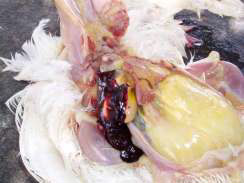
Hepatic pathology is a common problem observed by avian practitioners
in many diseases. Some diseases are specific to liver, but often the liver is
involved in disease processes that also affect a number of other organ systems.
Fatty Liver syndrome is one such condition, which has attracted the
attention of poultry breeders and Veterinarians alike. Fatty liver syndrome was
first described during 1950s as excessive fat in the liver associated with varying
degrees of hemorrhage. This condition is mostly confined to caged birds fed
high-energy diets, and often seen in summer months. The liver is usually
enlarged, yellow in colours and very friable. The abdominal cavity contains large
amounts of fat.
Fatty liver syndrome is an important metabolic disorder in laying flocks
after they reach peak in egg production. Liver is the main site of lipid biosynthesis
and is particularly very active in egg laying adult females. Yolk lipids and proteins
are secreted as lipoproteins under the influence of estrogen in the liver. When
hepatic lipogenesis exceeds the capacity of fat transport as lipoproteins,
triacylglycerols commence to accumulate in the liver, leading to fatty liver
syndrome. The type and level of certain fatty acids may play an important role in
the occurrence of this disorder. Certain fatty acids (i.e. conjugated linoleic acids)
inhibit the activity of this enzyme in the liver and cause lower levels of oleic acid,
which have a significant role in the secretion of triacylglycerols from chicken
hepatocytes compared to other fatty acids such as linoleic or palmatic acid.
Deficiency of linoleic acid may be associated with decreased metabolic
efficiency, and interfere with the absorption of other nutrients including calcium.
Paradoxically, lack of fatty acids can also result in fatty liver infiltration because
essential fatty acids are needed for lipid metabolism. If fats become rancid,
essential fatty acids may be destroyed, amino acid availability may be reduced
and peroxidases may be produced that interfere with the activities of fat and
water soluble vitamins (biotin).
It is also a biotin deficiency-related metabolic disease resulting in
impaired hepatic gluconeogenesis and increased fat deposition. The problem
is caused by low activity of the biotin dependent enzyme pyruvate carboxylase.
Birds die from hypoglycemia and the clinical signs and death are related to
hypoglycemia.
FLKS
FLKS in laying hens occur as a result of feeding a low protein, high
calorie ration to hens that are not laying enough eggs. In broilers this condition
occurs suddenly, as an outbreak usually associated with some management,
feed (perhaps fat level) or environmental change that affects feeding. Affected
broilers are usually well grown. Clinical signs include weakness with
uncoordinated behavior and head movement. The chicks may lie on their
breast with their neck and legs extended. Mortality may vary from 5 to 35%. At
PM the liver and kidneys are markedly enlarged, pale and fatty with abnormal
deposits of fat in subcutaneous tissues, abdominal cavity, and visceral organs.
The weights and sizes of the liver, kidney and heart increased, whereas the
weight of the thymus decreased?. In addition, the liver appears fragile, rounded
with light yellow or yellowish-brown colour. Birds with fatty liver syndrome have
40-70% fat in the liver on dry matter basis.
Metabolic Changes Associated with FLKS
Changes in metabolic measurements brought about by low-biotin diets
associated with high and low incidences of fatty liver and kidney syndrome
(FLKS):
Liver pyruvate carboxylase (pyruvate: CO2 ligase (ADP) activity will be
low in birds affected with FLKS resulting in significantly lower plasma
glucose concentrations. It is suggested that the cause of death in birds
with FLKS is a low rate of gluconeogenesis during periods without
feed, which results in lack of glucose to meet essential functions
Liver weights, blood lactate concentrations, plasma lactate
dehydrogenase activities and C16:1: C18:0 fatty acid in liver, adipose
tissue and plasma triglyceride will be increased in FLKS.
It may be concluded that FLKS occurs in birds with little or no hepatic
gluconeogenesis capacity via pyruvate carboxylase as a result of dietary
insufficiency of biotin. The initiation of the syndrome is probably associated with
the inhibition of other pathways of gluconeogenesis.
FLKS is frequently confused with fatty liver-haemorrhagic syndrome
(FLHS), but these two conditions are different: FLKS causes drop in egg
production as hens become increasingly obese, but little increase in mortality,
whereas FLHS causes increased mortality with little drop in egg production,
since affected hens die from hypovolaemic shock because of liver
haemorrhage. Usually hens that die are in full production. Some of the fat in the
liver in FLHS may lead to increased fragility and rupture of the liver. This may be
the result of high requirement for lipid in the egg yolk of hens in high production
and hens that do not die also have fatty livers.
Fatty liver-haemorrhagic syndrome occurs in commercial layers in high
production and is frequently the major cause of death in healthy flocks causing
up to 5% mortality during the laying cycle. Haemorrhage occurs from ruptured
livers. The liver in high production hens may be fragile because of large amount
of lipid present to supply lipid for the developing ova. Rupture and death
frequently occur during the increased abdominal pressure of egg laying.
There has been extensive research into the cause and prevention of
FLHS with higher incidence being reported in birds on a high-energy ration in
hot weather that could increase the fat content of the liver. Analysis of the fatty
acid composition of plasma phospholipids has indicated a difference between
normal and FLHS-susceptible laying hens.
However the composition of dietary lipids may be more important than
total dietary lipids. Rapeseed meal in the ration increases the incidence of
FLHS because erucic acid or other toxic products affect the strength of the
connective tissue in the liver.
Attempts have been made to prevent or treat the condition through diet
modification. Substituting carbohydrate with supplemental fat, while not
increasing the energy content of the diet seems to be beneficial. Presumably
such modification means that the liver needs to synthesize less fat for yolk. The
syndrome has reportedly been reduced through the use of various byproduct
feeds such as distiller's grains and fishmeal. Although the mode of action is unclear, unintentional supplementation of selenium may be involved. Fatty liver
syndrome is best prevented by not allowing an excessive positive energy
balance in older birds. Body weight can be monitored and when potential
problems are seen, remedial action taken to limit energy intake through the use
of lower energy diets and/or change in feed management. A wide energy:
protein ratio in the diet will aggravate fatty liver syndrome. On farms with history
of fatty liver syndrome, the diet should be supplemented with selenium and
vitamin E, appropriate levels of an antioxidants and liver stimulants.


